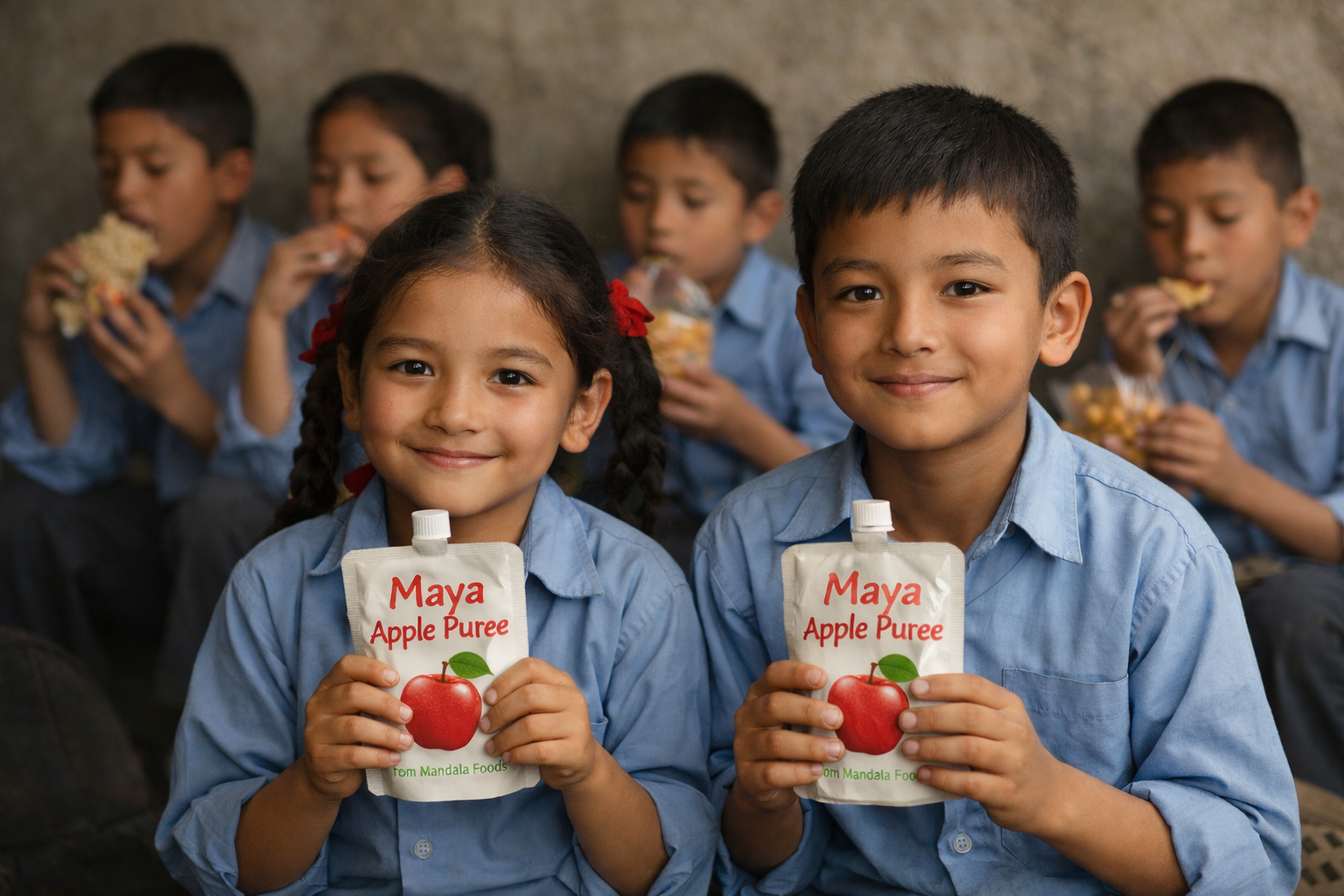
Contributed By: Reshma Shrestha
Charlotte, North Carolina
Reshma Shrestha is a mother and a part-time content creator for Mandala Foods.
Why School Food Is Important?
As parents and caregivers, we all want our children to learn well and succeed. We work hard every day, and in busy routines, school snacks are often chosen for convenience.
But what kids eat during school hours matters more than we realize.
Our kids spend 6–8 hours at school every day. The food they eat during school time affects:
- How well they can concentrate
- How much energy they have
- How their brain grows
- How well they learn and remember
- Optimal food and nutrition don’t just support health — it supports learning.
So, Do You Know What Our Children Are Eating at School?
Recent data from the Nepal Demographic and Health Survey 2022 and other studies reported in 2025 (covering 2022–2024) show a worrying trend.
Nearly 9 out of 10 school-going children in Nepal regularly consume ultra-processed foods (UPFs) during school hours.
These foods usually include biscuits and bakery items, candies and chocolates, instant noodles, chips and packaged snacks, and sugary drinks and sodas.
A 2025 study by researchers from Deakin University found that most packaged foods contain excessive amounts of sugar, salt, and unhealthy fats, exceeding one or more of the World Health Organization (WHO) recommendations. These foods fill the stomach but do not give children the nutrients they need to grow strong and healthy.
Why Does This Matter to Our Children?
When UPFs become the easy choice, children may experience:
- Difficulty focusing and learning in class
- A higher risk of becoming overweight or unhealthy
- Weak nutrition, even when children are eating enough food
- Dental problems like tooth decay
- Unhealthy eating habits that continue into adulthood
This means that poor food choices can affect not only children’s health, but also their education and future.
The School Food Environment Matters
A healthy school food environment isn’t just about lunch or snacks. It includes snacks sold inside schools, food vendors just outside school gates, what children bring from home, and what adults model as “normal” food.
Children tend to eat what is available, affordable, and socially accepted.
A Shared Responsibility

Children’s nutrition is not only a parent’s responsibility. Schools shape daily choices. Local governments set standards and budgets. Parents influence habits at home.
When these actors work together, children benefit not just in health, but in learning, confidence, and future potential. Improving school food is not about perfection.
It is about making the healthy choice the easy choice.
At Mandala Foods, we believe school meals are one of the most powerful and overlooked investments we can make in Nepal’s future.
To Our Readers
Tell us how we can make school meals healthy, affordable, and socially acceptable.
Please write to: info@mandalafoods.co
References:
- Ministry of Health and Population (MoHP), Nepal; New ERA; ICF.
Nepal Demographic and Health Survey 2022. Kathmandu, Nepal. - World Health Organization (WHO).
Guideline: Policies to protect children from the harmful impact of food marketing. WHO, Geneva. - Deakin University Research Group (2025).
Studies on nutrient profiling and ultra-processed foods sold in South Asian retail markets, assessing compliance with WHO nutrient recommendations. - UNICEF and World Health Organization.
School-age nutrition and cognitive development: Evidence and policy implications.